What is the best battery storage system for small commercial projects?
By enershareNovember 26th, 20269 views
What Is the Best Battery Storage System for Small Commercial Projects?
Most commercial battery buying guides tell you to define the goal, size the capacity, pick an architecture and check the certificates. That is sound advice — but on a small commercial site the decision is usually settled somewhere else: by how many electrician hours the install consumes, how quickly the system can be commissioned, and whether you can expand it later without starting the project again.
This guide looks at a modular high voltage stackable battery storage system through that lens, using published datasheet figures rather than marketing claims, and focuses on the three things small C&I installers actually buy: installation simplicity, installed cost, and flexibility. It then applies them to the sites that ask for them most — heat-pump-heated hotels needing winter backup, small offices, shops, cafés and other small public venues, where heat pump loads and a short, sharp winter peak meet a building that cannot close for an installation.
EnerShare Insights · Application and buying guide · For installers, project planners and small commercial operators · Updated November 2026
The system in one paragraph: The EnerShare EnerTower-HA16 is a modular high voltage stackable battery storage system built from 16.08 kWh LiFePO4 modules. Modules stack cable-free into clusters of 64.31–241.15 kWh, and up to four clusters run in parallel for a maximum of 964.8 kWh. Cell-level active balancing across the whole tower, 11000 cycles at 0.5P and 95% depth of discharge, IP65 protection, natural cooling and CAN/RS485 communication form the rest of the platform.
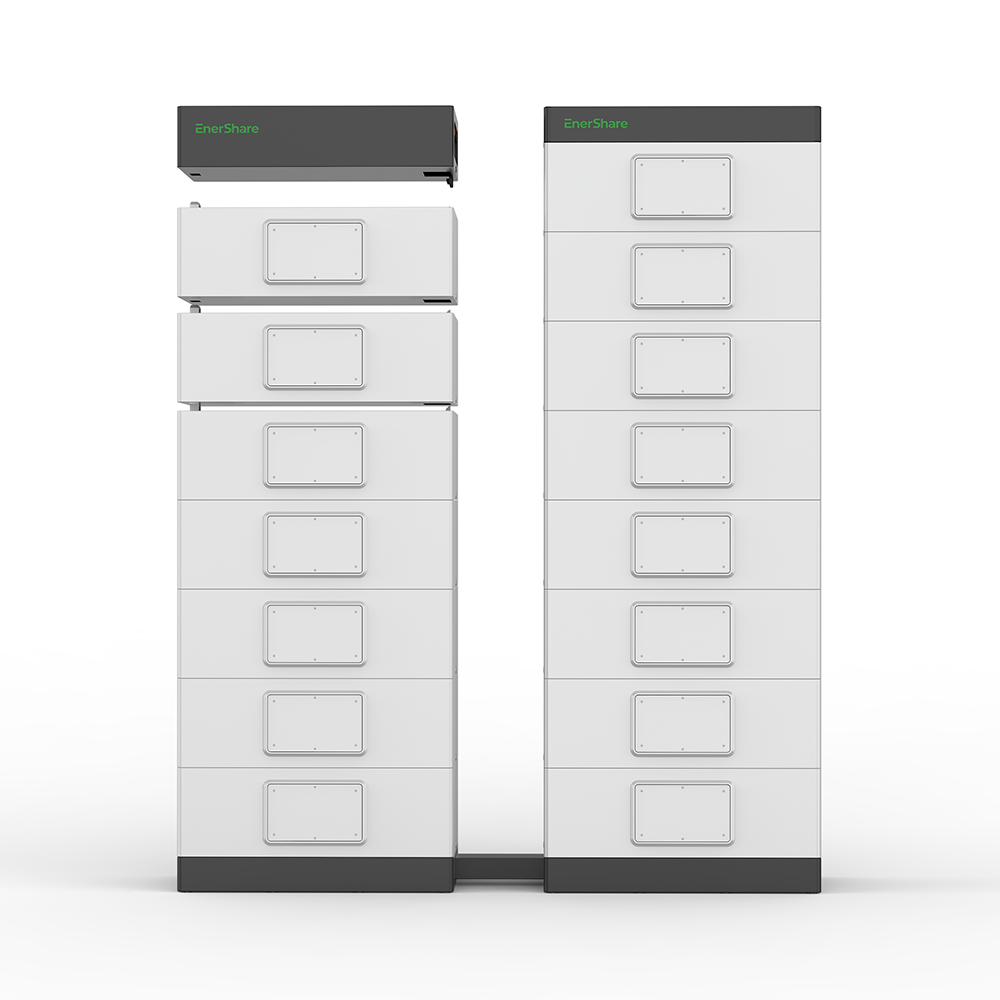
The EnerTower-HA16 stack: Column A (4–7 modules) and Column B (1–8 modules) share the same 770 × 435 mm footprint. View full product specifications.
1. Why Small C&I Is a Different Buying Problem
A commonly used working definition puts small commercial and industrial sites at roughly 20–300 MWh of annual consumption and 30–150 kW of peak demand: workshops, retail, offices, hotels, restaurants, cold stores, small factories, farms and multi-site chains. Below that band sits residential evening self-consumption; above it sits the containerised plant with a foundation, a fire strategy and a crane.
What separates the small site from both neighbours is not the battery — it is the building. There is no spare plant room, no resident maintenance team, no tolerance for closing the shop during an install, and often no second chance at an installation window. Three consequences follow, and they should drive the purchase order:
Commissioned savings, not quoted savings. A demand-charge reduction starts on the day the system is energised, not the day it is ordered. Lead time and installation labour are commercial variables, not logistics details.
Installed cost, not €/kWh. At this scale, cells are the abundant input. Qualified electrician hours, lifting equipment and rework are the scarce ones.
Today's load, tomorrow's load. A site that adds a heat pump, a production line or EV chargers should not have to replace the BMS or re-engineer the room.
That is why a modular stack is best evaluated as an installation method with a capacity range attached, rather than as a single kWh number.
2. Installation Advantages: What Actually Changes on Site
The architecture removes several field operations that consume time on conventional rack or cabinet installs. The following points are taken from the EnerTower-HA16 datasheet and product documentation.
Cable-free, plug-and-play stacking
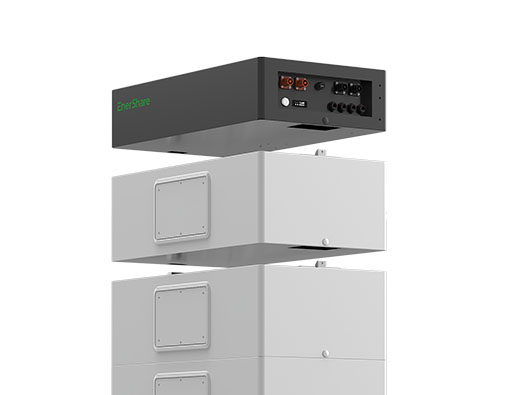
Modules lock together mechanically and connect electrically through integrated connectors on top of each unit — there is no field-terminated DC harness between levels, no torque specification to apply and no loom to route. Moving the connection into the factory removes the annual terminal re-torque task that dominates service time on conventional racks, and lets a single module be unplugged and replaced without dismantling the stack or re-commissioning a string.
Modules connect directly module-to-module: no DC harness, no torqued terminals between levels.
Floor-standing, small footprint, standard access
Both tower columns use the same 770 × 435 mm footprint and the same 16.08 kWh module, so capacity scales by module count rather than by redesign. Units are floor-standing and stackable — no rack, no foundation, no crane. A 770 mm-wide unit typically fits through a standard door, which is what lets a basement, mezzanine plant room, occupied retail unit or service alley stay in scope for the project.
No cooling plant, no cooling maintenance
The system uses natural cooling — no fans, no HVAC, no coolant loop and no maintenance schedule for cooling. Combined with IP65 protection (optional IP20), C3 anti-corrosion grade and a −20 to 55 °C discharge range, a tower can sit against a wall, in an unheated plant room or in a sheltered outdoor position without building a dedicated conditioned room around it. An optional heater version covers charging below 0 °C.
Safety and commissioning built in
Fire suppression: built-in Nano Solid Novec1230 releases in 3 seconds at a 130 °C trigger.
BMS and communication: CAN / RS485 ports are standard, with an optional WiFi module for remote operation and maintenance and a 3-second fast response.
Cell-level active balancing across the whole cluster keeps cell voltages consistent and slows degradation over the cycle life.
Inverter compatibility: Solis, Deye, Growatt, Solinteg and Megarevo are listed as compatible — the inverter you already install does not have to change.
Honest boundary on handling. The official specification lists a module weight of 118 + 2 kg (approximately 120 kg). Positioning therefore requires a suitable stacking aid or lifting frame and must follow local manual-handling rules — this is not a hand-lifted module. The real labour saving is the elimination of cabling, torque checks and harness rework, plus a shorter, simpler placement task; electrical connection, commissioning and grid registration still belong to a qualified electrician. Always confirm the current datasheet and site risk assessment before planning crew size.
3. Cost Advantages: Think in Installed Cost, Not Price per kWh
A cheaper battery that takes two extra days to install, needs an HVAC service contract and cannot be extended is not the cheaper system. Five cost levers matter on a small commercial project, and each one is supported by a datasheet value:
Cost lever
What the platform provides
Why it matters on a small site
Lower initial capital
Start at 4 modules / 64.31 kWh per cluster; 12 configuration steps up to 241.15 kWh
Commission at today's load instead of pre-buying capacity for a future that may not arrive
No repeat engineering on expansion
More modules per tower, more towers per bank; up to 4 clusters in parallel (964.8 kWh) without replacing the BMS or re-engineering the room
Expansion is additive — no new design work and no re-engineering of the room
Long service life
11000 cycles @ 25 °C ± 2 °C, 0.5P, 95% DoD; 94% DC efficiency; cell-level active balancing
Usable energy and efficiency persist over more years, spreading the investment over more cycles
Fewer maintenance visits
Natural cooling (no fans), cable-free connections (no terminal re-torque), optional WiFi for remote O&M
Fewer truck rolls and less planned downtime — the dominant operating cost on unstaffed sites
Shorter installation and commissioning window; savings start sooner
No invented payback figures. Actual savings and payback depend on the local tariff structure, demand-charge rules, load profile, installation cost, financing, system efficiency and utilisation. Ask for a calculation built on your interval data rather than a generic years-to-payback claim; any vendor model assuming one full cycle every day and a 100% peak shave should be treated as a planning illustration only.
4. Flexibility: Twelve Capacity Steps on One Architecture
A single cluster of the EnerTower-HA16 is configured from 4 to 15 modules, giving twelve rated capacity steps from 64.31 kWh to 241.15 kWh. Column A holds 4–7 modules, Column B up to 8, and the two share the same footprint and module — so the room layout does not change as capacity grows.
Modules
Model
Rated energy
Nominal voltage
4
ESS-204.8/314
64.31 kWh
204.8 V
5
ESS-256/314
80.38 kWh
256.0 V
6
ESS-307.2/314
96.46 kWh
307.2 V
7
ESS-358.4/314
112.54 kWh
358.4 V
8
ESS-409.6/314
128.61 kWh
409.6 V
9 (4+5)
ESS-460.8/314
144.69 kWh
460.8 V
10 (5+5)
ESS-512/314
160.77 kWh
512.0 V
11 (5+6)
ESS-563.2/314
176.84 kWh
563.2 V
12 (6+6)
ESS-614.4/314
192.92 kWh
614.4 V
13 (6+7)
ESS-665.6/314
209.00 kWh
665.6 V
14 (7+7)
ESS-716.8/314
225.08 kWh
716.8 V
15 (7+8)
ESS-768/314
241.15 kWh
768.0 V
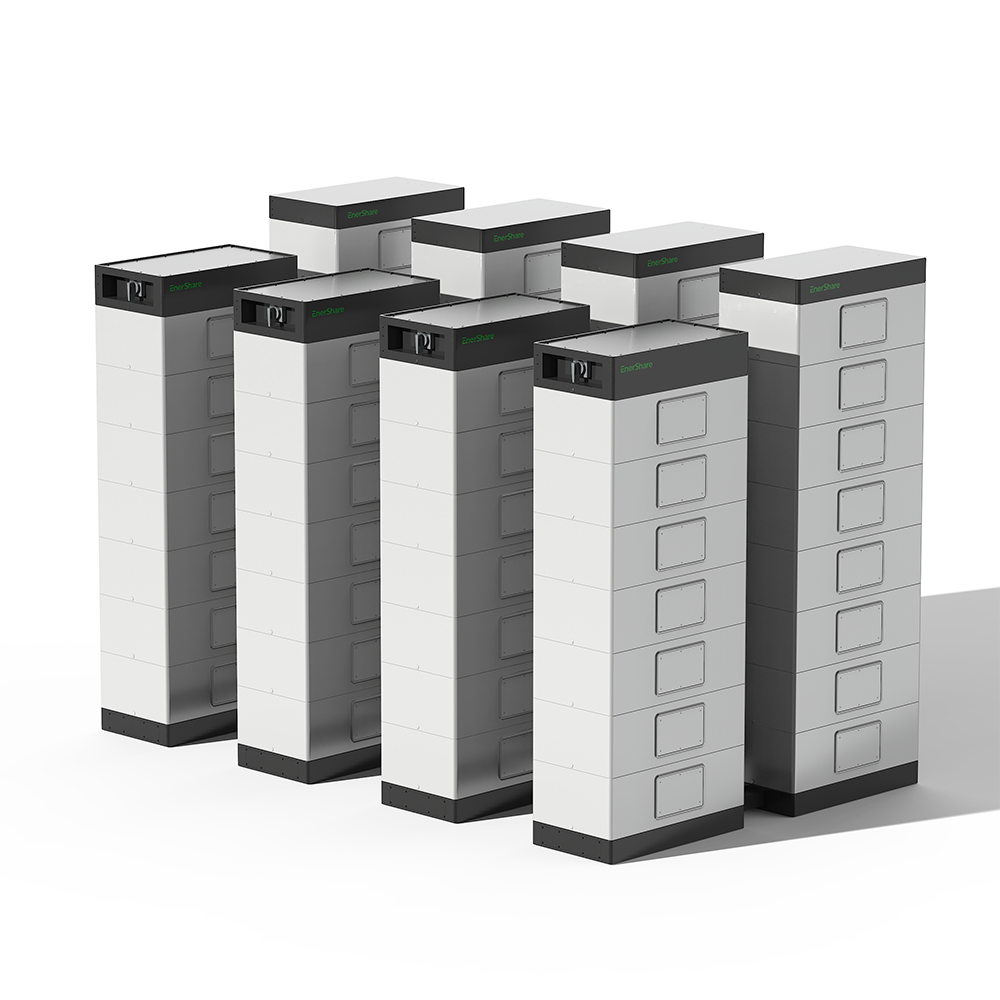
Parallel expansion then continues the same logic: 2 clusters → 482.3 kWh, 3 clusters → 723.45 kWh, 4 clusters → 964.8 kWh. Cell-level active balancing across every cluster keeps the towers consistent as the bank grows. Because the same 16.08 kWh module and 770 × 435 mm footprint are used throughout, a multi-site rollout can reuse one bill of materials and one installation playbook.
Start at 64 kWh, grow to nearly 1 MWh: up to four clusters run in parallel on the same architecture.
Keep kW and kWh separate. The system's recommended and maximum continuous current is 157 A per cluster, with a nominal voltage window of 204.8–768.0 V and a 0.5P cycle-life rating. Power is set by current limits and the inverter, not by the nameplate capacity. If a site needs sustained high power or full-shift shifting, size that requirement explicitly with your supplier rather than adding modules.
5. Where It Fits: Small Commercial Installation Scenarios
The advantages are not evenly distributed. They concentrate on sites that are small, occupied, access-constrained or multiplied across a chain — and on sites where heating has become an electrical load. For hotels with heat pumps and winter backup requirements, see the dedicated section that follows.
Scenario
Site constraint
What the modular stack delivers
Hotels with heat pumps — winter backup
Heating cannot stop in winter, occupancy peaks, no spare plant room, generator start gap
3-second fast response keeps heating and guest services running; off-peak charging covers the morning heat-pump ramp; −20–55 °C discharge and an optional heater version suit unheated plant areas. See section 6.
Small offices
Occupied daytime hours, no on-site maintenance staff, short morning peaks, no tolerance for a multi-day install
Cable-free stacking shortens the on-site window; a 770 × 435 mm floor-standing tower fits a wall or corner; optional WiFi allows remote O&M across a portfolio
64–241 kWh per bank for peak shaving and critical-load backup; 3-second response protects chillers, refrigeration and POS; natural cooling needs no service contract
Cafés and other small public venues
Short, sharp peaks from espresso machines and ovens, trading hours that cannot be interrupted, chain rollouts
157 A continuous current per cluster buffers appliance peaks; one standard BOM and one stacking method repeat across every site
Workshops and light industrial
Dust, unheated rooms, semi-outdoor placement
IP65, C3 anti-corrosion and −20–55 °C discharge tolerate difficult environments without a conditioned enclosure
Distributed / multi-site projects
Every site is a new design and a new crew plan
Standard BOM, same stacking method, each bank scaled independently from 64 kWh toward 964.8 kWh
Solar self-consumption
Midday surplus, expensive evening tariff windows
Pairs with a compatible hybrid inverter to store PV surplus; CAN/RS485 standard, WiFi optional for remote O&M
EV charging support
Constrained connection, charging peaks
157 A continuous current per cluster buffers charging loads on the existing supply
General backup power
Generator start delay, grid events
3-second fast response keeps operations running without a generator start sequence
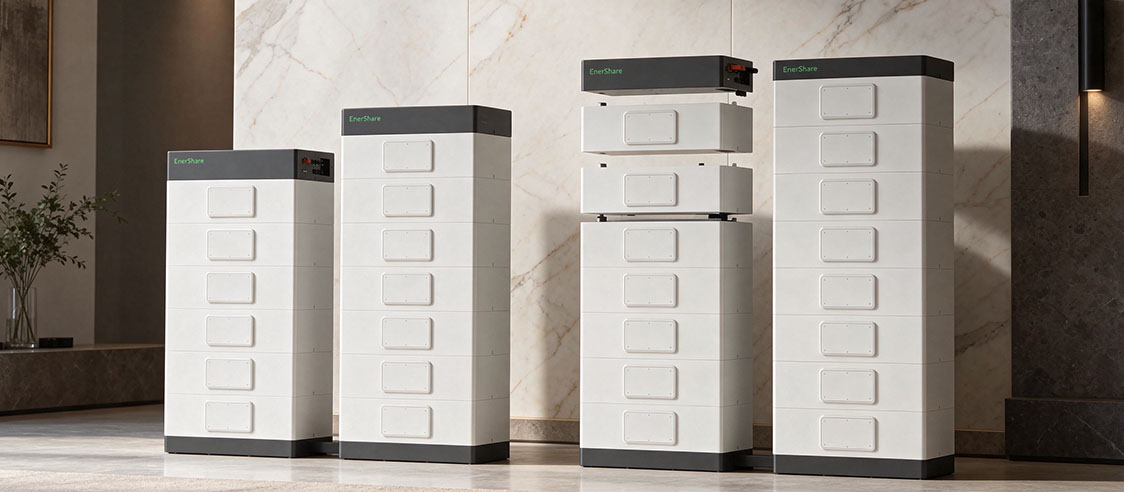
Floor-standing towers in an occupied commercial building: no dedicated plant room, no structural works.
6. Heat Pump Pairing and Winter Backup Power for Hotels
Switching a building's heating from gas to an electric heat pump creates two problems at once: a much higher winter demand peak, and a blackout that now means no heat. Hotels feel both most sharply — a cold room cannot be sold, frozen pipes are a real risk in a prolonged winter outage, and breakfast service, laundry and domestic hot water all sit behind the same electrical supply. Winter is also the season when rooftop PV produces the least, exactly when the heat pump needs the most.
Why a heat pump changes the storage calculation
The heat pump often becomes the largest single electrical load. In cold months it can dominate the site's half-hourly demand, especially after a boiler replacement.
The peak is short and sharp. Morning warm-up ramps, defrost cycles and falling COP at low ambient temperatures create narrow spikes — precisely the intervals that set a demand charge for the whole billing period.
Backup becomes a heating requirement, not a lighting requirement. A generator start gap of even a few minutes is noticeable in a guest room; an extended outage in freezing weather is a property-risk issue.
PV and heat pump load are seasonally mismatched. Short days and low winter irradiance mean a system sized purely for summer PV self-consumption will be undersized for the heating season.
Four ways the battery works alongside the heat pump
Operating mode
What happens
Why it matters in winter
Peak shaving the morning ramp
Battery discharges during heat-pump start-up and defrost spikes
Clips the short peak that would otherwise set the month's demand charge
Off-peak / night charging
Charge on low-tariff night electricity, discharge into the daytime heating load
Lowers the weighted cost of winter heating without changing the heat pump
Backup bridging
3-second fast response covers the gap until a generator starts or the grid returns
Heating and guest services stay live; reduces frozen-pipe and room-out-of-service risk
PV self-consumption
Store midday PV surplus for the evening
Useful in shoulder seasons, but a supplement in winter — do not size a hotel backup system on summer PV yield
Sizing for winter, not for a summer PV profile
State two separate numbers before choosing a configuration: the continuous power the heat pump and other critical loads need, and the backup duration the site must cover. Capacity alone does not answer either.
Use 30 days of 15-minute interval data that includes heat-pump operation, plus the heat pump nameplate and compressor start current. Compressor inrush and defrost behaviour must be checked against the inverter and the 157 A continuous current per cluster — this is the kW-versus-kWh distinction from section 4 applied to a real load.
Set backup duration against a consecutive overcast, low-temperature, high-occupancy case, not against average daily consumption. Decide explicitly which circuits sit on the critical-load panel; a whole-building, full-load, multi-hour backup claim should not be assumed.
Check the temperature envelope: discharging −20 to 55 °C, charging 0 to 55 °C (optional heater version −20 to 55 °C). Natural cooling, IP65 protection and C3 anti-corrosion let a tower sit in an unheated plant area or sheltered outdoor position without taking guest or trading floor space.
Stage the investment. Start at 64.31–128.61 kWh for current occupancy and add modules or clusters before the next winter season — the same 16.08 kWh module and 770 × 435 mm footprint mean no room redesign when a second heat pump or an EV charger arrives.
Small offices, shops, cafés and other small public venues
The same platform serves smaller public-facing sites, but the requirement is different. A hotel needs duration and heating continuity; a small office, shop or café needs short peak coverage, no closure during install, and minimal floor space. What they share is no resident maintenance team, trading hours that cannot be interrupted, and a sharp morning or lunchtime load spike from HVAC, lighting, refrigeration, espresso machines or ovens.
Install without closing the door. Cable-free stacking and floor-standing placement shorten the on-site window, so work can be scheduled outside trading hours.
Fit the space you have. A 770 × 435 mm tower goes against a wall in a back office, storeroom or service corridor — no rack, foundation or dedicated plant room.
Protect what actually loses money. The 3-second response covers refrigeration, POS and payment terminals rather than attempting to carry the entire building; define that critical-load list during commissioning.
Run a chain from one playbook. CAN/RS485 plus the optional WiFi module supports remote monitoring, and one standard bill of materials repeating across sites keeps each new café or shop a copy of the last.
Two honest boundaries. First, CAN/RS485 and the optional WiFi module are communication interfaces — heat-pump-aware scheduling is delivered through a compatible hybrid inverter or an external EMS, so confirm the exact inverter model and the EMS integration scope before promising any control logic. Second, no universal backup-hour figure is given here: runtime depends on the selected critical loads, ambient temperature, state of charge and inverter limits, and must be calculated from the site's own data.
7. Key Specifications from the Official Datasheet
Parameter
Value
Battery type
LiFePO4, cobalt-free
Module / combination
16.08 kWh, 51.2 V, 314 Ah, 1P16S · 4–15 modules in series per cluster
Nominal energy
64.31 – 241.15 kWh per cluster · up to 964.8 kWh with 4 clusters in parallel
Nominal / operating voltage
204.8 – 768.0 V · 182.4 – 852.0 V
Recommended / max continuous current
157 A / 157 A
Depth of discharge / cycle life
95% · 11000 cycles @ 25 °C ± 2 °C, 0.5P
DC efficiency / cooling
94% · natural cooling
Communication / remote monitoring
CAN / RS485 standard · optional WiFi module for remote O&M · 3 s fast response
Charging 0–55 °C (optional heater version −20–55 °C) · discharging −20–55 °C · max 3000 m, derating above 2000 m
Fire safety
Nano Solid Novec1230, 3 s response, 130 °C trigger
Compatible inverters
Solis, Deye, Growatt, Solinteg, Megarevo
Certification
IEC 62619, CE, UN38.3
Source: EnerTower-HA16 official datasheet. Confirm the current revision and the approved configuration for your inverter before ordering.
8. Procurement Checklist: Six Questions Before You Order
Buying guides commonly warn against choosing capacity before defining the goal, focusing only on purchase price, ignoring future expansion, confusing kW with kWh and skipping certification checks. On a modular stack — especially one paired with a heat pump — those warnings translate into six concrete questions:
Which module count and cluster layout matches our 30-day, 15-minute interval load data? A weak answer is a single kWh figure with no power or duration discussion.
What continuous power and backup duration do the heat pump and critical loads require? For hotels, ask for the calculation at low ambient temperature and high occupancy, including compressor start current and the critical-load panel list. A weak answer quotes a kWh number with no inrush or duration check.
Is our inverter model on the approved compatibility list, and over which protocol (CAN or RS485)? A weak answer is "compatible with all hybrid inverters".
What is the module weight, what lifting aid is assumed, and what does the install crew plan look like? A weak answer omits manual-handling requirements entirely.
How many field-terminated DC connections remain, and what is the annual maintenance scope? A weak answer avoids the torque-check question.
Which certificates and test reports cover this exact configuration, and what is the warranty term? A weak answer is a generic declaration for a different assembly.
Market-specific requirements. The published certification set covers IEC 62619, CE and UN38.3. Projects in the US may additionally require system-level UL 9540A test data and NFPA 855 installation compliance — confirm the documentation scope for the target market with the supplier before the permit stage. US projects should not assume a module-level certificate extends to a multi-cluster assembly.
9. Frequently Asked Questions
What is a small C&I modular high voltage stackable battery storage system?
A commercial storage system built from stackable LiFePO4 modules that connect in series to reach a higher DC voltage. The EnerTower-HA16 uses 16.08 kWh modules, cable-free stacking, 64.31–241.15 kWh per cluster and up to four clusters in parallel for 964.8 kWh.
Why is a stack cheaper to install than a cabinet on a small site?
Because the field work is placement rather than cabling: no module-to-module DC harness, no torque specification, no cooling plant, no rack and no crane. Floor-standing units on a 770 × 435 mm footprint fit through standard doors and into occupied buildings. Actual savings depend on local labour rates and site access.
Can one technician install a tower?
Positioning requires a stacking aid or lifting frame — the datasheet lists a module weight of approximately 120 kg — and must follow local manual-handling rules. Electrical connection, commissioning and grid registration require a qualified electrician. The labour saving comes from fewer cabling and rework tasks, not from hand-lifting modules.
Can I expand later without replacing the inverter or BMS?
Capacity is additive: add modules within a cluster (4–15 modules, twelve rated steps) or add clusters in parallel (2 → 482.3 kWh, 3 → 723.45 kWh, 4 → 964.8 kWh) on the same architecture. Cell-level active balancing keeps clusters consistent. Confirm the inverter voltage window and approved configuration before each expansion.
Does it need a dedicated plant room or HVAC?
No. Natural cooling removes fans and coolant loops, and IP65 protection with C3 anti-corrosion and a −20–55 °C discharge range supports wall-side, unheated or sheltered outdoor placement. Ventilation, service access and local fire-code separation distances still apply.
Can a modular high voltage battery be paired with a heat pump?
Yes — the usual arrangement is a compatible hybrid inverter or an external EMS controlling the battery through CAN/RS485. In practice the battery clips the morning warm-up and defrost peaks, charges on off-peak night tariffs, and bridges the gap during a grid event with a 3-second response. Size the continuous power and the backup duration separately: the datasheet specifies 157 A continuous current per cluster, not a heat-pump-specific power rating, so compressor start current must be checked with the supplier.
How much winter backup runtime does a hotel need?
There is no universal figure. Runtime depends on which circuits are on the critical-load panel, ambient temperature, state of charge and inverter limits. For a hotel, model the consecutive overcast, low-temperature, high-occupancy case and state the required hours explicitly — do not assume whole-building, full-load backup from a nameplate kWh value. The system's −20 to 55 °C discharge range and optional heater version for sub-zero charging are relevant here, as is the fact that winter PV yield is at its lowest.
Is it practical for a small office, shop or café with no plant room?
That is one of the better fits. A 770 × 435 mm floor-standing tower goes against a wall in a back office or storeroom, cable-free stacking shortens the installation window so trading hours are not lost, and natural cooling removes the maintenance contract. Define the critical loads — refrigeration, POS, payment terminals, lighting — and let the 3-second response cover those rather than attempting to carry the whole building. Optional WiFi monitoring suits a chain of sites.
Which inverters are compatible?
The official datasheet lists Solis, Deye, Growatt, Solinteg and Megarevo, with CAN/RS485 communication standard. Send the exact inverter model and required capacity — the voltage window and recommended module count should be verified before you order.
What maintenance does the system need?
Remote monitoring of cell voltage, temperature and state of charge, periodic firmware updates and an annual visual inspection. Because the stack is cable-free and naturally cooled, there is no module-to-module terminal torque check and no cooling maintenance schedule.
Send us your load profile — we will size the towers.
Share 30 days of 15-minute interval data, your tariff structure, the inverter model and — for heat pump or winter backup projects — the heat pump nameplate, your critical-load list and the backup duration you need to cover. Our application engineers will return a module count, cluster layout and inverter match for your hotel, office, shop or café project, typically within one business day.